2026 Best Pallet Transfer Conveyor Types for Global Buyers
For global buyers, selecting the right Pallet Transfer Conveyor is more than comparing prices and motor ratings. In 2026, warehouses must handle varied pallet sizes, heavier loads, tighter layouts, and faster production cycles. A conveyor that performs well in a clean factory may struggle with dust, moisture, or uneven pallets.
This guide examines the main pallet transfer conveyor types used in manufacturing, storage, and distribution facilities. Options include chain transfer conveyors, roller transfer units, turntables, shuttle systems, and lift-based solutions. Each design creates a different balance between transfer speed, load stability, floor space, maintenance, and integration cost. Small details matter. A 2-millimeter height difference can affect pallet movement. Poorly positioned sensors can cause repeated stops.
Practical selection begins with the pallet itself. Buyers should confirm dimensions, weight, base structure, surface condition, and transfer direction before requesting quotations. The conveyor must also match the surrounding equipment, including forklifts, automated storage systems, robotic stations, and safety controls. Supplier experience matters, but product claims still require verification through drawings, test reports, warranty terms, and reference projects.
No single system fits every facility. A low-cost solution may create higher maintenance costs later. A technically advanced system may be unnecessary for a simple transfer point. This guide offers a balanced comparison for international buyers, while recognizing that site conditions can change the final decision. Careful planning remains essential.
What Is a Pallet Transfer Conveyor and How Does It Work?
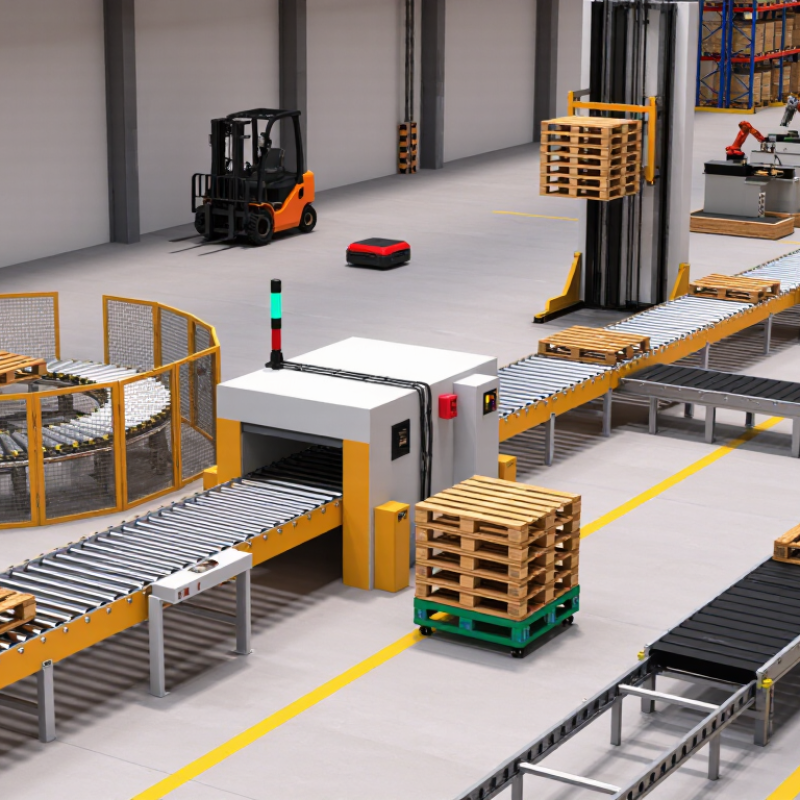
A pallet transfer conveyor moves loaded pallets between conveyor lines, workstations, storage lanes, and loading points. It is not simply a powered roller bed. The system combines rollers or chains, a transfer mechanism, sensors, guides, and controls. When a pallet arrives, sensors confirm its position and clearance. A lift table raises it, or a chain transfer moves it sideways. The controller checks the destination before releasing the pallet. One missed sensor can stop an entire lane.
The mechanism matters. Roller transfers suit stable, flat-bottom pallets and frequent direction changes. Chain transfers handle heavier or rougher pallet bases, though they may mark fragile loads. Turntables rotate pallets where floor space is limited. Pop-up units are compact, but their lifting stroke requires precise alignment.
In field commissioning, small alignment errors often become repeated stoppages. The design is rarely perfect.
Grand View Research valued the global warehouse automation market at USD 18.1 billion in 2022 and forecasts a 16.7% CAGR from 2023 to 2030. MHI’s 2024 Annual Industry Report also identifies robotics and automation as major investment priorities.
Buyers should verify load weight, pallet dimensions, throughput, transfer gaps, noise, and emergency stopping. Test the worst pallet, not the newest one. Warped, wet, or unevenly loaded pallets can expose weaknesses that factory tests miss. Document those exceptions before selecting equipment.
Main Pallet Transfer Conveyor Types for Different Material Flows
2026 Best Pallet Transfer Conveyor Types for Global Buyers
Main Pallet Transfer Conveyor Types for Different Material Flows
Pallet transfer conveyors should match the material flow, not only the available floor space. Roller transfer conveyors suit stable pallets moving along straight, high-volume routes. Powered rollers provide controlled movement and reliable accumulation. They handle wooden and plastic pallets well, provided the pallet runners remain flat and undamaged.
Chain transfer conveyors work across parallel conveyor lines. They lift pallets slightly, move them sideways, and lower them onto the next route. This design supports heavy loads and frequent transfers. It is useful for production lines, storage aisles, and cross-docking areas. However, poor pallet alignment can cause impact, noise, and uneven loading.
Belt transfer conveyors offer smoother contact for lighter pallets or sensitive goods. They reduce vibration but may require more maintenance when dust or loose packaging enters the belt path. Lift-and-carry units are effective when pallets must change direction without turning the load. Turntables provide another option for compact layouts, especially where pallet orientation must change.
I have seen projects fail because engineers measured conveyor width but ignored pallet entry conditions. Measure twice. Check load weight, pallet gaps, transfer frequency, and stopping accuracy. Global buyers should also review voltage, guarding, emergency controls, and local safety requirements with qualified integrators. No layout works perfectly on paper. Real pallets are often less consistent than specifications suggest.
How to Compare Pallet Transfer Conveyor Designs and Features
When comparing pallet transfer conveyor designs, begin with the pallet, not the catalog. Measure length, width, weight, bottom-board spacing, and surface condition. Roller transfers suit rigid pallets with consistent undersides. Chain transfers handle uneven bottoms better, but they may create more noise and wear. Belt transfers can protect sensitive loads, although debris and belt tracking need closer attention. MHI’s 2024 Industry Report found that 83% of surveyed supply-chain professionals believe technology investment is necessary. That figure supports automation, but it does not justify choosing the fastest conveyor.
Capacity and transfer accuracy deserve practical testing. Compare rated load with your heaviest real pallet, not an average value. Check transfer speed, stopping distance, accumulation pressure, and cycle time under peak demand. A 1,000-kilogram rating can mislead when the load is poorly centered. Ask for test results using your pallet dimensions. Small errors become expensive.
Controls and maintenance often separate workable designs from troublesome ones. Look for adjustable sensors, accessible drive components, guarded pinch points, emergency stops, and clear fault messages. The U.S. Bureau of Labor Statistics continues to identify transportation and material-moving work as a major employment category, making operator interaction a serious design factor. Choose controls that workers can understand quickly. Keep spare parts practical. I have seen specifications focus on speed while ignoring cleaning access, which later slows production. A better comparison includes energy use, noise, service intervals, floor space, and integration with existing control systems. Fast is not always efficient.
Installation, Safety, Maintenance, and Integration Requirements
For global buyers in 2026, pallet transfer conveyors should match load weight, routing, and production rhythm. Chain conveyors suit heavy pallets and harsh environments. Roller conveyors support smooth accumulation and scanning. Lift-transfer units handle cross-flow movement where floor space is limited. Fit matters. MHI’s 2024 Annual Industry Report found that 55% of supply chain leaders expected higher technology investment. That spending should begin with a measured site survey, not a catalog selection.
Installation requires level floors, accessible service zones, and verified pallet clearances. Installers should record frame alignment, transfer height, motor capacity, and emergency-stop locations. Guards must protect nip points and moving chains. Lockout/tagout procedures should follow applicable local rules, while risk assessments can reference ISO 12100 and ISO 13849-1. Small gaps matter. A poorly positioned photoelectric sensor can stop an entire line.
Maintenance plans should include weekly cleaning, chain tension checks, roller inspection, and sensor testing. Keep critical bearings and drive components identified, but avoid excessive spare inventory. Integration is equally important. Conveyors should exchange status signals with PLC, warehouse software, barcode readers, and safety circuits. The International Federation of Robotics reported 541,302 industrial robots were installed worldwide in 2023, showing why reliable machine communication matters. In practice, commissioning often exposes overlooked details, such as unstable pallets or incomplete fault codes. That is where the design should be questioned.