2026 Top Black Rectangular Hollow Section Suppliers
Black Rectangular Hollow Section (RHS) is valued for its clean geometry, useful strength-to-weight ratio, and straightforward fabrication. It appears in building frames, equipment supports, gates, and transport structures. In 2026, buyers comparing suppliers need more than a low price per tonne. They need consistent dimensions, dependable lead times, and clear documentation. Small differences matter. A few millimetres can affect a tight connection or disrupt a production run.
The World Steel Association’s World Steel in Figures 2025 reports 1,882.6 million tonnes of crude steel production worldwide in 2024. That figure shows the scale of the steel industry, but it is not an RHS-specific market estimate. A supplier’s stock claims therefore deserve direct checking. Ask about section sizes, wall thickness, steel grade, standard, available lengths, and mill test certificates. Confirm whether “black” describes an uncoated, mill-finish surface; terminology can vary between sellers. Also check bundle labels and traceability before material reaches the workshop. Look closely.
This guide considers suppliers through practical questions: Can they provide the required section consistently? Do their documents match the delivered product? Can they explain tolerances and expected delivery dates clearly? Relevant standards may include ASTM A500 or EN 10210 and EN 10219, depending on the product and project. These standards are not interchangeable by default. A polished website is not proof of quality, and even a complete certificate cannot replace sensible incoming inspection. There is room for judgment here. The best supplier is usually the one whose claims are specific, verifiable, and consistent from quotation to delivery.
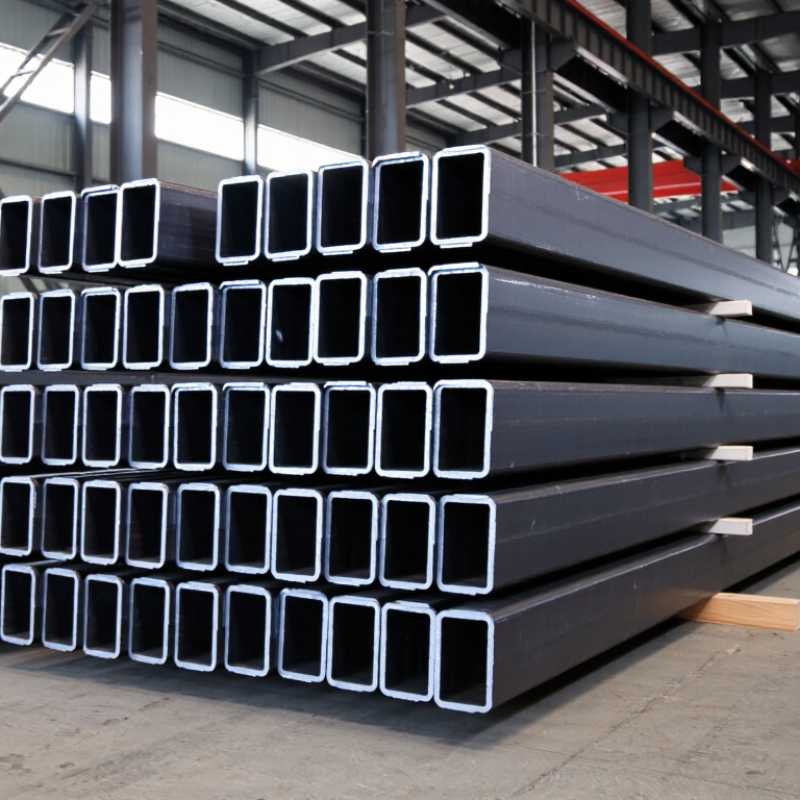
What Black Rectangular Hollow Sections Are and How They Are Used
Black rectangular hollow section (RHS) is a closed steel profile with four flat sides and a hollow center. It is commonly made by forming steel strip into a rectangle and welding the seam. “Black” usually describes its dark, uncoated surface, not a special structural grade. Dimensions refer to the outside width and height; wall thickness affects weight, stiffness, and load capacity. Check the product specification, since finish and tolerances can vary.
The shape offers useful bending resistance in two directions, while its flat faces simplify connections. Fabricators use RHS for building frames, machine guards, shelving, gates, handrails, and equipment supports. For example, a 100-by-50-millimeter section can be positioned with its broad face against a frame, making a clean joint easier to clamp. Its suitability still depends on span, loads, steel grade, and connection details—not appearance alone.
Black RHS can be cut and welded using common steelworking methods, but exposed edges and welds need attention. The dark surface is not reliable corrosion protection; moisture can cause rust, especially inside open ends or around joints. For outdoor use, specify a suitable coating and consider drainage or sealed ends. Small details matter. Trapped water can remain inside a tube that looks sound, and a quick visual check cannot confirm its load capacity.
How the 2026 Black RHS Supplier Market Is Organized
2026 Top Black Rectangular Hollow Section Suppliers
How the 2026 Black RHS Supplier Market Is Organized
The black RHS market is organized less by branding than by production scale, stock depth, and processing capability. Large mills typically supply standard sections in bulk, while regional service centers hold popular sizes for shorter lead times. Smaller distributors may offer cut-to-length pieces, but availability can vary. The distinction is not tidy.
The World Steel Association reported global crude steel production of 1,882.6 million tonnes in 2024, showing the scale of the upstream supply base. The OECD’s 2025 Steel Outlook projected global steelmaking capacity could reach about 2,485 million tonnes by 2027. For buyers, that matters: broad capacity does not guarantee local stock of a specific wall thickness or length.
A capable supplier should state the RHS dimensions, wall thickness, steel grade, applicable standard, and whether the surface is mill-finished or treated. Ask for a test certificate and confirm tolerances before comparing prices. Check bundle labels, too; a small mismatch can disrupt fabrication. Fast delivery is useful. Verified stock is better. Yet even careful checks cannot remove every delay, especially when transport or production schedules shift.
Leading Black RHS Suppliers to Consider in 2026
Leading Black RHS Suppliers to Consider in 2026
Choosing a black rectangular hollow section supplier takes more than comparing price per tonne. The World Steel Association reported global crude steel production of about 1.89 billion tonnes in 2023, showing the scale of a market where product consistency still needs close checking. Shortlist suppliers that can provide mill test certificates, clear dimensional tolerances, and dependable delivery dates. Ask for section dimensions, wall thickness, steel grade, and available lengths in writing. Small variations matter. They can complicate fit-up on site.
A capable supplier should explain whether its black RHS is supplied with a mill finish and how that affects storage, fabrication, and later corrosion protection. Request sample inspection records and confirm how damaged or out-of-tolerance material is handled. Check that quoted tolerances match the project specification, not just a general product sheet. That detail is easy to miss. Delivery capacity also deserves scrutiny: a low quote means little if staged shipments arrive late or vary between batches. Supplier claims should be verified against documents and recent project references.
Tips: Compare like-for-like grades, thicknesses, and lengths. Ask for a sample certificate before ordering. Store sections off wet ground, and inspect bundles on arrival. One caveat: the cheapest source may suit a simple job, but it is not automatically the best choice for tight fabrication tolerances.
How to Compare Supplier Quality, Standards, and Availability
Choosing a black rectangular hollow section supplier in 2026 takes more than comparing prices. Ask how the supplier checks wall thickness, outside dimensions, straightness, and weld seams. Request a sample inspection report and a mill test certificate linked to the relevant batch. Details matter. A neat surface can hide uneven coating or a size variation that complicates fabrication.
Check which product standard the section is supplied to, and confirm that it matches your project drawings and specification. Ask for the standard’s exact designation, not just a general claim of compliance. Compare coating type and thickness too, especially when sections will face outdoor exposure. Ask for evidence. If a certificate lists a different grade or batch, pause and clarify before ordering. Small paperwork gaps are easy to overlook.
Availability needs the same scrutiny as quality. Request written confirmation of the exact sizes, wall thicknesses, quantities, and finish currently in stock. Then verify lead time, delivery method, and whether partial shipments are possible. A supplier may have “stock” but not the dimensions you need. That can happen. Before committing, compare how clearly each supplier answers technical questions and handles changes. A careful review still cannot prevent every delay, but it can reveal vague promises while there is time to adjust.
2026 Top Black Rectangular Hollow Section Suppliers: How to Compare Supplier Quality, Standards, and Availability
For a like-for-like quality check, compare the steel grade stated on the supplier’s documents with the applicable standard and verify it against the material test certificate. This chart shows minimum yield strength for selected EN 10219 structural hollow section grades at nominal thicknesses of 16 mm or less; it does not rank suppliers or indicate stock availability. Confirm dimensions, finish, certification, lead time, and current availability directly with each supplier.
Key Checks Before Choosing a Black RHS Supplier
Before choosing a black rectangular hollow section supplier, confirm the exact size, wall thickness, steel grade, and length you need. Details matter. Ask how dimensional tolerances are measured, especially at the corners, where wall thickness can vary. A clear quotation should state these requirements rather than simply list “RHS” and a price.
Check that material certificates match the supplied batch and include traceable heat or batch numbers. Ask whether stock is measured before dispatch; a tape measure and caliper can quickly confirm length and wall thickness on a sample. Inspect the black surface, too. Mill scale, light surface rust, and storage marks may affect handling or later fabrication. Clarify how sections are bundled, protected, and loaded, particularly if they will travel in wet weather. A document alone is not enough.
Compare lead times, minimum order quantities, cutting options, and replacement procedures for out-of-spec material. Ask for recent delivery references or arrange a sample inspection when the order is large. I would not judge reliability by the lowest quote alone; however, a high price does not guarantee consistent stock either. That is easy to overlook. Keep the agreed grade, dimensions, tolerances, and delivery date in writing, and check that the final invoice uses the same specifications.