

-
Solutions
-

Waterworks

Pressure Reducing
Pressure Sustaining / Pressure Relief
Flow Control valves
Float Valves - Level Control
Electrically Actuated Valves
Pressure Modulation - Remote Control
Altitude Valves - Level Control
Burst Control Valves
Pump Control
CLA-VAL "HYTROL" Main Valve
Valve Controllers and Data Loggers
Air Valves
See all
Waterworks
-

Military Fuelling
-
- About us
- Blog
- Support
- Contact


Blog
2026 Best Hydraulic Cylinder Seals for Industrial Use?
Choosing the best Hydraulic Cylinder Seals for industrial use in 2026 requires more than comparing catalog prices. Seal performance depends on pressure, temperature, fluid compatibility, stroke speed, and contamination levels. A seal that works reliably in a clean factory press may fail quickly in a dusty excavator. Small details matter. Rod finish, groove accuracy, and installation tools can determine service life.
This guide examines practical seal options for demanding hydraulic systems. It considers polyurethane, nitrile rubber, PTFE, and advanced elastomer compounds. Each material offers different strengths. Polyurethane often handles abrasion well. PTFE performs effectively under heat and low-friction requirements. Nitrile remains useful in many mineral-oil applications. However, no material suits every cylinder. Engineers should verify manufacturer data, pressure ratings, temperature limits, and fluid compatibility before selection.
Real maintenance experience also reveals a less comfortable truth. Many seal failures begin with poor installation, not weak materials. A scratched rod can damage a new seal within hours. Misalignment may create uneven wear across the sealing lip. Contamination is another common problem. Even the best design can fail in harsh conditions. This overview uses established engineering principles, field-based observations, and careful comparison methods to identify reliable choices. Some recommendations may require further testing because operating conditions vary between machines. Treat this guide as a decision-making foundation, not a substitute for application-specific validation.
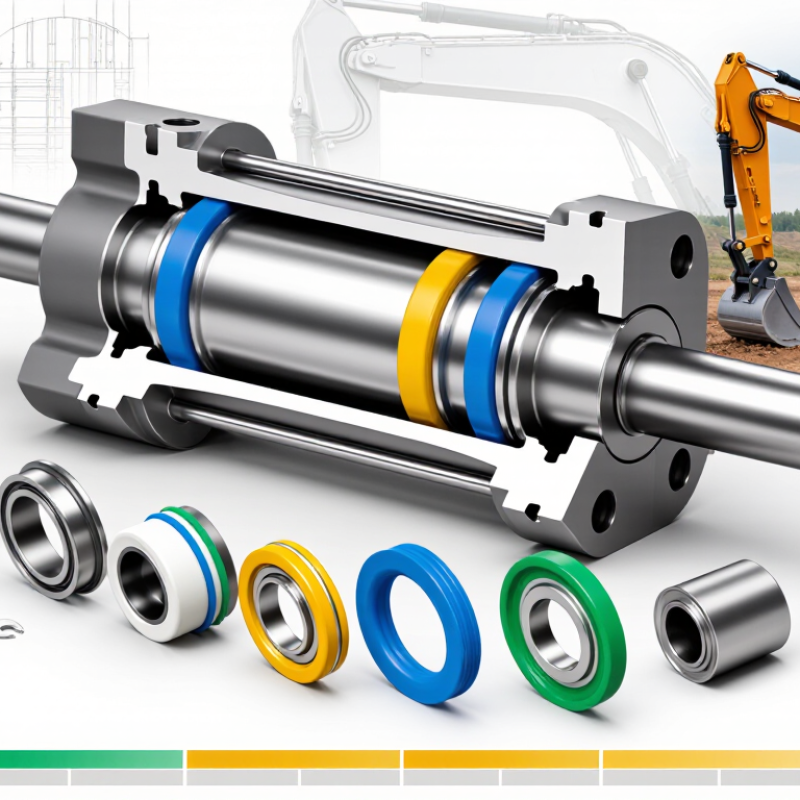
Hydraulic Cylinder Seals: Definition, Functions, and Industrial Importance
Hydraulic cylinder seals are engineered barriers inside a cylinder assembly. They separate pressurized fluid from air, dust, and external moisture. Rod seals control leakage around the moving rod. Piston seals maintain pressure between chamber sides. Wipers remove abrasive particles before they enter the barrel. Small details matter. A thin oil ring may indicate normal lubrication, or early seal failure. Field experience shows that temperature, side loading, and contamination often matter more than catalog pressure ratings.
Seal performance depends on material compatibility, hardness, speed, pressure, and installation quality. Polyurethane suits many mobile applications, while PTFE-based compounds can handle demanding temperatures and low friction. According to a 2024 MarketsandMarkets analysis, the hydraulic seals market is projected to grow at roughly 5% annually through 2029. That growth reflects expanding industrial automation and equipment maintenance needs. Yet market growth does not make every seal suitable.
Industrial importance is practical. A damaged seal can reduce force, increase pump workload, stain floors, and stop production. U.S. Department of Energy guidance identifies hydraulic leakage as a notable source of wasted energy in poorly maintained fluid-power systems. ISO 4413 also emphasizes cleanliness, safety, and controlled maintenance. In real workshops, the best seal is not always the most expensive. It is the one matched to fluid, pressure, motion, temperature, and groove design. My own caution is simple: replacement without root-cause inspection can repeat the failure. Not always. Sometimes the cylinder rod is the problem.
2026 Best Hydraulic Cylinder Seals for Industrial Use? - Hydraulic Cylinder Seals: Definition, Functions, and Industrial Importance
| Seal Material | Primary Seal Types | Typical Operating Temperature | Typical Pressure Capability | Compatible Hydraulic Fluids | Main Advantages | Key Limitations | Recommended Industrial Applications |
|---|---|---|---|---|---|---|---|
| Polyurethane (PU) | Rod seals, piston seals, wipers, static seals | -40°C to +110°C (-40°F to +230°F) | Typically up to 250–400 bar, depending on profile, clearance, and extrusion protection | Mineral-oil hydraulic fluids, lubricating oils, and many water-glycol fluids | Excellent abrasion resistance, high tear strength, good extrusion resistance, and strong dynamic sealing performance | Limited resistance to sustained high temperatures, steam, hot water, and some aggressive chemicals | Mobile equipment, material-handling systems, construction machinery, and general-purpose hydraulic cylinders |
| Nitrile Rubber (NBR) | Rod seals, piston seals, O-rings, static seals | -30°C to +105°C (-22°F to +221°F) | Typically up to 200–300 bar, depending on seal geometry and installation conditions | Mineral oils, petroleum-based hydraulic fluids, and lubricating oils | Balanced cost, good oil resistance, reliable flexibility, and broad industrial availability | Lower resistance to ozone, weathering, and high temperature than specialty elastomers; unsuitable for many phosphate-ester fluids | Standard industrial power units, factory automation, agricultural equipment, and moderate-temperature cylinders |
| Fluorocarbon Rubber (FKM) | Rod seals, piston seals, O-rings, static seals | -20°C to +200°C (-4°F to +392°F) | Typically up to 250–400 bar, subject to profile design and anti-extrusion support | High-temperature mineral oils, synthetic oils, fuels, and many chemically aggressive fluids | Very good high-temperature performance, chemical resistance, and low gas permeability | Higher cost; limited suitability for hot water, steam, and some low-temperature applications; can be damaged by rapid decompression | High-temperature presses, steel-processing equipment, chemical-process machinery, and demanding industrial cylinders |
| Polytetrafluoroethylene (PTFE) | Piston seals, rod seals, step seals, backup rings | -60°C to +200°C (-76°F to +392°F) | Typically up to 400–700 bar when properly energized and supported against extrusion | Mineral oils, synthetic fluids, water-glycol fluids, and many chemically aggressive media | Very low friction, excellent chemical resistance, wide temperature range, and suitability for high-speed movement | Lower elasticity than rubber; often requires an energizer, accurate housing dimensions, and careful surface-finish control | High-performance cylinders, servo-hydraulic systems, chemical equipment, and low-friction applications |
| Ethylene Propylene Rubber (EPDM) | Rod seals, piston seals, O-rings, static seals | -50°C to +150°C (-58°F to +302°F) | Typically up to 150–250 bar, depending on compound and seal profile | Water-based hydraulic fluids, water-glycol fluids, phosphate-ester fluids, and hot water | Excellent resistance to water, steam, ozone, weathering, and phosphate-ester fluids | Generally incompatible with petroleum-based oils and mineral-oil hydraulic fluids | Water-hydraulic systems, fire-resistant fluid systems, outdoor equipment, and hot-water service |
| Fabric-Reinforced NBR | Heavy-duty rod seals, piston seals, V-packings | -30°C to +100°C (-22°F to +212°F) | Typically up to 300–500 bar in heavy-duty sealing arrangements | Mineral-oil hydraulic fluids and petroleum-based hydraulic oils | High mechanical strength, strong extrusion resistance, and suitability for shock loads and large-diameter cylinders | Higher friction than many modern compact seals; requires suitable gland design and adequate lubrication | Mining equipment, hydraulic presses, injection-molding machinery, and heavy industrial cylinders |
Note: Temperature and pressure values are typical engineering ranges rather than universal ratings. Actual performance depends on seal profile, compound formulation, cylinder clearance, surface finish, speed, pressure cycling, fluid condition, and installation quality.