Who Is the Best PVC Layflat Hose Supplier in China?
Choosing the best Pvc Layflat Hose supplier in China takes more than comparing quotations. The hose may look similar in a product photo, yet wall thickness, reinforcement, coupling fit, and batch consistency can differ. These details matter when a hose is dragged across a farm, connected to a pump, or rolled repeatedly after use. Small differences can become costly.
Grand View Research estimated the global industrial hose market at about US$13.4 billion in 2023. Its report covers a broad range of industrial hoses, not Pvc Layflat Hose alone, so the figure is useful context—not proof that any supplier is superior. Buyers should verify product-specific claims through technical datasheets, samples, and documented quality checks. Ask for working pressure and burst-pressure test results, material specifications, dimensional tolerances, and inspection records. Then compare like with like. A low price means little if the hose kinks under flow or its fittings leak.
A reliable supplier should also explain how it controls raw materials, production batches, and final testing. Request references or evidence of experience with applications similar to yours. Check whether the supplier can provide clear packaging details, realistic lead times, and responsive after-sales support. That matters. Even a capable factory can miss a requirement when specifications are vague; buyers should review their own assumptions, too. The best choice is therefore not a name picked from a ranking, but a supplier whose measurable performance matches the job.
What PVC Layflat Hose Is and How It Is Made
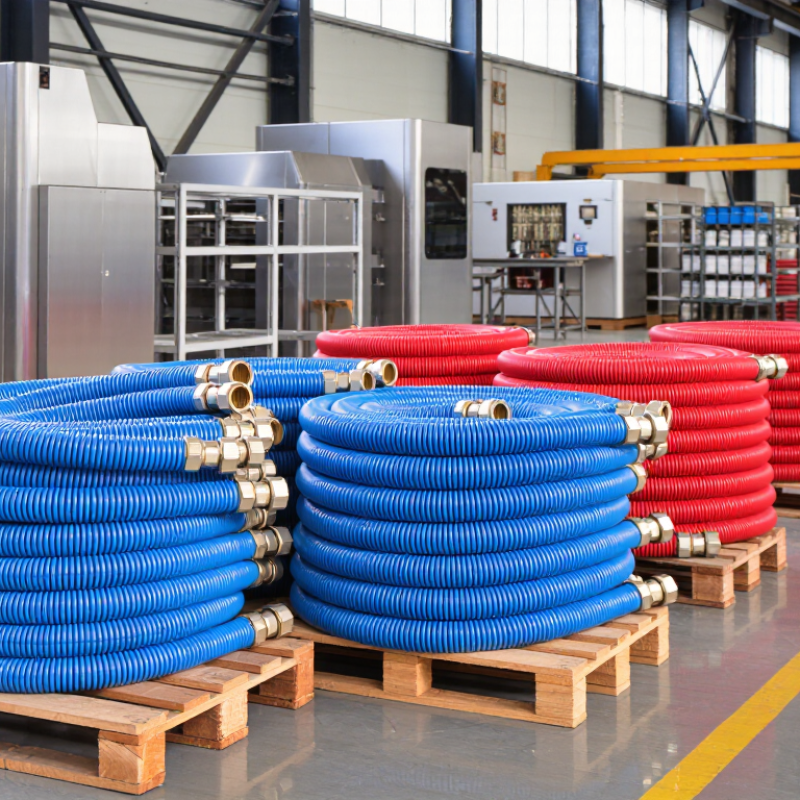
PVC layflat hose is a flexible water-delivery hose designed to flatten when empty. Its wall usually combines PVC with a woven polyester reinforcement. The PVC helps resist water and weather exposure, while the yarn carries pressure loads. Construction varies by use, so a hose for farm irrigation may not suit high-pressure drainage.
A common process starts by extruding a PVC tube, then placing it around or through a circular-woven polyester jacket. Some designs receive an additional PVC coating. Heat and pressure bond the layers, creating a smooth outer surface and a reinforced core. The finished hose is cooled, cut, and checked for leaks, dimensions, and pressure performance. Small defects matter.
In practice, wall thickness, yarn density, and bonding quality affect flexibility and service life. A hose that feels sturdy in the hand may still have weak seams; visual checks alone are not enough. The VinylPlus 2024 Progress Report records 737,645 tonnes of PVC recycled in Europe in 2023. That figure covers PVC across applications, not layflat hose specifically. Recycled content should therefore be assessed against the hose’s pressure and durability requirements, rather than treated as an automatic quality benefit.
Key Applications and Performance Requirements
PVC layflat hoses are used for irrigation, tank filling, and temporary water transfer on farms. They are also common on construction sites, where crews move water away from excavations. When empty, the flat profile makes storage and transport easier. That convenience matters when hoses are moved between fields or packed into a small service vehicle.
Small details matter. A hose used across gravel needs a tougher outer surface than one laid on smooth ground. Even then, dragging it over sharp edges can shorten its service life.
Performance requirements depend on the job. Check the working pressure against the pump output, including possible pressure surges during startup or valve closure. A safety margin is sensible. Reinforcement, wall thickness, and hose diameter all affect pressure capacity, flexibility, and flow, so comparing products by appearance alone can mislead. PVC performance can also change with temperature; confirm the rated operating range for the intended conditions. Match couplings carefully to avoid leaks or sudden separation.
A specification sheet may not reflect every field condition, though. Before regular use, inspect the hose and test the complete setup at the expected pressure.
How to Evaluate PVC Layflat Hose Suppliers in China
Evaluating PVC layflat hose suppliers in China requires more than comparing quoted prices. Plastics Europe’s Plastics—The Fast Facts 2024 reports global plastics production of 413.8 million tonnes in 2023, with China accounting for 33.3%. This scale indicates a large manufacturing base, not consistent hose quality. Ask each supplier for a current product specification and traceable test records. Check working pressure, burst pressure, inner diameter, wall thickness, and coupling fit. Details matter.
Request samples from the same production grade you plan to buy. Lay a hose across a rough floor, fill it, and inspect for leaks, bulges, and uneven flattening. Ask how pressure tests are performed and whether results identify the tested batch. A quality certificate can help, but it does not replace product-level evidence. ISO 9001 describes a quality management system, not a guarantee that every hose meets your requirements. Look for clear answers on PVC formulation, reinforcement yarn, UV exposure, and temperature limits. No perfect supplier exists. I would also check how quickly the supplier reports defects and supports a repeat order; that part is easy to overlook.
Comparing Supplier Quality, Pricing, and Production Capacity
Who Is the Best PVC Layflat Hose Supplier in China?
Comparing Supplier Quality, Pricing, and Production Capacity
A strong supplier comparison starts with test records, not catalogue claims. Ask for working-pressure and burst-test results for the exact hose diameter and wall thickness you plan to buy. Check whether samples remain round, resist kinking, and hold their fittings after repeated filling and draining. Small differences matter. Grand View Research estimated the global PVC market at about USD 67.5 billion in 2023, with continued growth projected through 2030. This broader market figure is useful context, but it does not prove any supplier’s hose quality or capacity. Request traceable batch records and confirm how often production checks are performed. A certificate alone can leave gaps.
Compare prices on an equal specification: diameter, length, reinforcement, fittings, packaging, and delivery terms. A lower quote may omit couplings or use thinner walls. Ask for a written breakdown. For capacity, request monthly output by hose type, current lead times, and evidence of recent shipments. If possible, inspect the line while it runs; a clean sample room tells only part of the story. Also ask how the factory handles rejected batches and peak-season orders. These answers can be imperfect, and that is worth noting: stated capacity is not the same as available capacity. Check it against production schedules and delivery records.
Who Is the Best PVC Layflat Hose Supplier in China?
A practical framework for comparing supplier quality, pricing, and production capacity
Suggested buyer-defined evaluation weights—not measured market data or scores for specific suppliers. Verify quality with product specifications and test reports, compare prices for equivalent hose specifications, and assess capacity using documented output and lead times.
Steps for Choosing a Supplier for Your Project
Choosing a PVC layflat hose supplier starts with the job site, not the catalog. Define the required inner diameter, working pressure, delivery length, water temperature, and exposure to sunlight or abrasion. Ask for a written specification and a sample. Check its wall thickness and fabric reinforcement; a neat-looking surface alone proves little. That detail is easy to miss.
Grand View Research’s 2024 PVC market report estimated the global market at USD 72.6 billion in 2023. This signals a large, competitive supply chain, not consistent hose quality. Compare suppliers using documented burst-pressure and hydrostatic-test results, and ask how test samples match the finished production batch. ISO 1402 describes hydrostatic testing for rubber and plastics hoses; confirm which applicable test method the supplier uses. Request traceable inspection records, not just a general certificate.
Check that sample dimensions match the quote, including tolerances and coupling fit. Clarify whether quoted pressure applies at your operating temperature. Ask about production capacity, lead time, packaging, and how defects are handled. Then verify the details with a small trial order where practical. I would still double-check the paperwork against the actual sample; specifications can be incomplete, and that is worth catching early.