10 Best Solar LED Wall Lights for Outdoor Use
Choosing the right Solar Led Wall Lights can transform a dark entrance, garden path, or patio into a safer, more welcoming space. Yet the brightest model is not always the best choice. Battery capacity, panel placement, sensor accuracy, weather resistance, and installation height all affect real outdoor performance.
Professor Martin Green, a leading photovoltaic researcher, has said, “Solar energy is the most abundant energy resource on Earth.” His observation explains the appeal of solar lighting, but it does not remove practical limits. A shaded wall may receive weak charging. Winter nights can expose poor battery design. Heavy rain can reveal weak seals.
This guide examines 10 Best Solar LED Wall Lights for Outdoor Use through useful, everyday criteria. We consider brightness, beam coverage, charging time, runtime, motion detection, materials, and mounting flexibility. We also look beyond product specifications. A light that claims long runtime may perform differently beside a tall fence or beneath a covered porch.
Details matter.
For example, a warm light can make brickwork look inviting, while a cooler beam may improve visibility near steps. A wide-angle fixture suits a driveway, but a narrow beam may better highlight a doorway. Some lights are easy to install, yet their small panels demand careful positioning.
No product is perfect. That deserves attention. The best Solar Led Wall Lights balance dependable illumination, reasonable maintenance, and honest performance in changing weather. Our selections aim to help homeowners compare these trade-offs clearly, rather than chase impressive numbers alone.
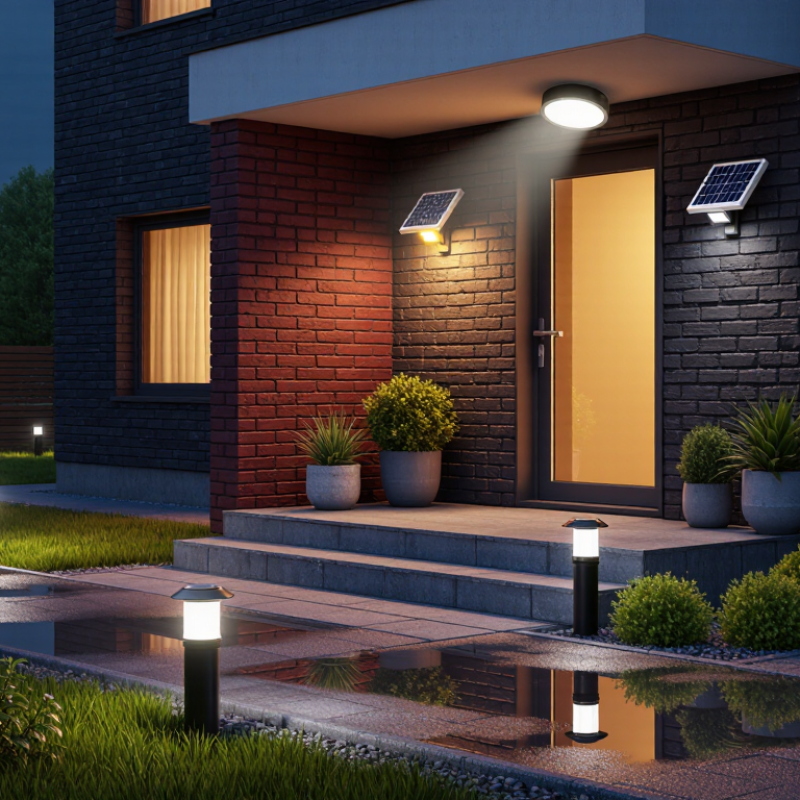
Solar LED Wall Light Basics: Photovoltaic Efficiency, Battery Capacity, and LED Output
Solar wall-light performance starts with the small photovoltaic panel, but its rated efficiency is only part of the story. Fraunhofer ISE’s Photovoltaics Report 2024 places average commercial crystalline-silicon module efficiency at roughly 22%. Compact light panels may differ, so that figure is a reference, not a product guarantee. Panel angle, shade, and short winter days affect the energy collected. A panel beneath a deep eave may receive far less sunlight than expected. Numbers can mislead.
Battery capacity is easier to compare in watt-hours: multiply volts by amp-hours. A 3.7-volt, 2-amp-hour battery stores 7.4 watt-hours before losses. In theory, it could power a 1-watt LED for 7.4 hours; real runtime will be shorter because controllers reserve energy and conversions waste some power. The U.S. Department of Energy reports that LEDs use at least 75% less energy than incandescent lighting, but brightness still needs checking in lumens. For a doorway, a modest, even beam may be more useful than a high lumen claim. I would still test the light through several cloudy nights; one sunny evening proves little.
Outdoor Evaluation Standards: IP65 Protection, 100–200 lm/W Efficacy, and Runtime
When comparing solar LED wall lights, treat IP65 as a useful baseline, not a promise of indestructibility. The rating indicates dust-tight construction and resistance to water jets; it does not mean a fixture can be submerged. Check seals around the lens, cable entry, and mounting plate, where rain can collect. A quick visual inspection after installation is worthwhile.
Efficiency claims need context. A stated 100–200 lm/W may describe LED efficacy, rather than light delivered by the complete solar fixture. Check whether figures reflect measured output at the wall, and compare brightness at the same setting. A narrow, glaring beam may report impressive lumens yet leave steps unevenly lit. Look for an even spread across the path.
Judge runtime under realistic conditions. An eight-hour claim may assume a full charge, mild temperatures, and low brightness. Shaded panels, winter days, and an aging battery can shorten evenings. If possible, test the light after several cloudy days, then note when dimming begins. That check is imperfect, but more useful than a headline number.
Ten Best Solar LED Wall Lights Ranked by Brightness, Durability, and Value
Ranking ten solar LED wall lights requires more than comparing headline brightness. Record each fixture’s lumens, motion-sensor behavior, battery capacity, and runtime after a full charge. A bright beam can illuminate a gate clearly, yet disappoint after cloudy days. Small details matter. For durability, inspect the housing, seals, mounting hardware, and stated weather-resistance rating. Compare these details with the installation site: a sheltered porch faces different conditions from an exposed fence.
The U.S. Department of Energy reports that LED bulbs use at least 75% less energy and can last up to 25 times longer than incandescent bulbs. That comparison concerns LED bulbs, not the lifespan of a complete solar fixture; its battery and panel can wear differently. For value, weigh useful light and replacement-part availability against the purchase price. A lower-cost light may be a sensible choice for a walkway, but less so for a dark entrance used every night. Still, ratings do not tell the whole story.
Tips: Test the light after dusk, then check its runtime before relying on it. Aim the panel toward open sky, away from branches and roof shadows. Keep notes for several nights; results can vary with weather and season.
Installation and Performance Factors: Sunlight Exposure, Beam Angle, and Sensors
10 Best Solar LED Wall Lights for Outdoor Use
Solar wall-light performance starts with the panel’s view of the sky. NREL’s National Solar Radiation Database provides hourly solar and weather data, helping installers compare seasonal sunlight at a specific location. Check winter conditions, not just annual averages: a panel shaded by eaves or a nearby tree may recharge poorly during short days. Even a few hours of direct sun can matter. Wipe off dust and check for new shade as plants grow. Small detail. Big effect.
Beam angle and sensor setup shape what the light actually does. At three metres high, a nominal 90-degree beam spreads about six metres across, though real brightness falls toward the edges. Narrow beams suit doorways; wider beams cover paths and patios. Aim the fixture at the walking surface, not a neighbor’s window. Sensor range is not the same as dependable detection: a person crossing its field may trigger it more reliably than someone approaching straight on. Test after dusk. Adjust the angle, sensitivity, and shutoff time, then repeat on a colder night. Cold weather and cloud cover can expose weak charging sooner than a quick daytime test suggests. IES lighting guidance also supports matching distribution to the task, rather than choosing by claimed brightness alone.
Maintenance, Battery Lifespan, and Seasonal Efficiency in Outdoor Conditions
Outdoor solar wall lights need simple, regular care. Wipe each panel with a damp microfiber cloth when dust, pollen, or bird marks build up. Check the lens and housing for cracks, loose screws, and trapped moisture. One overlooked detail: a shaded panel can matter more than a slightly dirty one.
Winter brings shorter days, lower sun angles, and more cloud cover, so charging may fall and nightly run time may shrink. NREL’s National Solar Radiation Database provides weather and solar-resource data that show why output varies by location and season. In a 2013 review, researchers Dirk Jordan and Sarah Kurtz examined nearly 2,000 photovoltaic degradation rates and reported a median of 0.5% per year. That figure concerns conventional PV systems, not compact lamp panels, but it offers useful context. Rechargeable batteries also lose capacity with age, heat, and repeated cycling; check the light’s manual before replacing one.
Tips: Clear snow from the panel after storms, and avoid scraping its surface. Let the light charge through a full sunny day before judging its battery. If it still dims early, inspect for shade or a tired battery—sometimes the cause is less obvious than it seems.
10 Best Solar LED Wall Lights for Outdoor Use
Typical outdoor performance comparison covering nightly runtime, battery replacement interval, and winter output retention. Values represent realistic specification ranges for residential solar LED wall lights and exclude brand-specific data.
How to read this chart: Longer runtime indicates stronger overnight performance, while a higher winter retention percentage suggests better seasonal efficiency. Battery replacement intervals depend on charge cycles, temperature, and maintenance.