Pressure Reducing
Pressure Sustaining / Pressure Relief
Flow Control valves
Float Valves - Level Control
Electrically Actuated Valves
Pressure Modulation - Remote Control
Altitude Valves - Level Control
Burst Control Valves
Pump Control
CLA-VAL "HYTROL" Main Valve
Valve Controllers and Data Loggers
Air Valves
A high speed pick and place robot moves parts between defined locations at a rapid, repeatable pace. On a factory floor, that might mean lifting small components from a moving conveyor and placing them into trays, cartons, or assembly fixtures. The work looks simple. The engineering is not.
Robotics pioneer Rodney Brooks wrote, “The world is its own best model.” That idea matters here: a robot must respond to real parts, lighting, conveyor motion, and occasional misalignment—not just an ideal drawing. Cameras, grippers, motion controls, and software must work together. A missed grip or delayed correction can disrupt the line.
Speed alone is not enough. A useful system must also place items accurately and keep operating reliably across changing shifts and products. Its cycle time depends on the task, robot design, payload, reach, and the time needed to grip and release each part. There is no single speed figure that describes every installation.
The label can mislead. Some systems are called “high speed” without explaining the conditions behind that claim. Buyers should ask what was measured, with which payload, and under what operating conditions. They should also consider maintenance, safety provisions, and integration with existing equipment.
This introduction explains how these robots work, where they are used, and what to assess before choosing one. The practical trade-off deserves attention: a faster movement may not improve output if feeding, inspection, or downstream packaging becomes the bottleneck. Real production is less tidy than a demonstration.
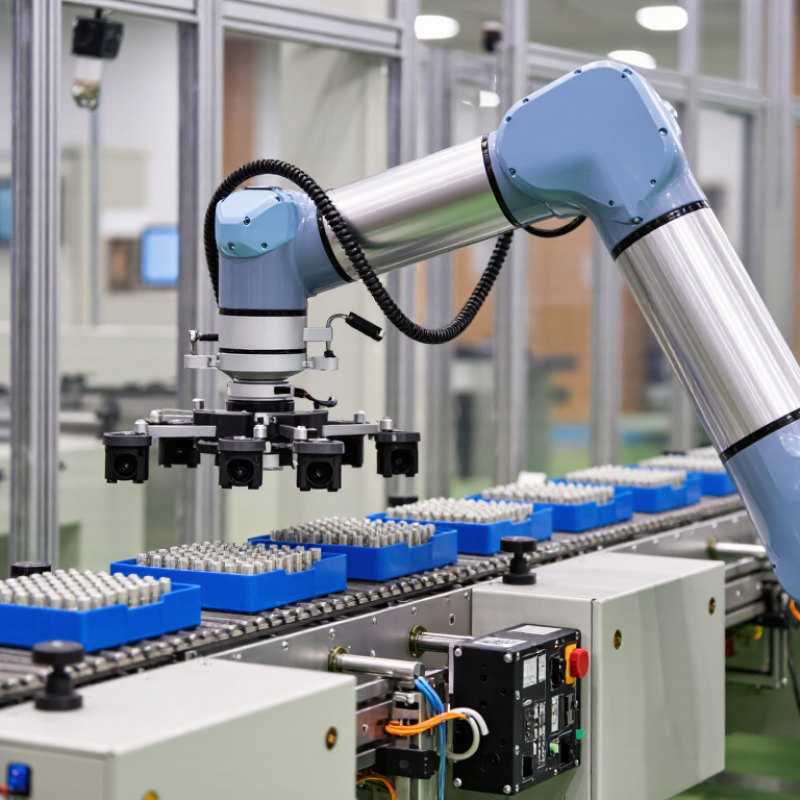
A high-speed pick-and-place robot is defined by how quickly and reliably it transfers items between locations. It must accelerate, reach, grip, and release parts within a short cycle. Speed is not just arm movement. Small details matter.
The robot’s payload, reach, tooling, and motion path all affect its real working rate. A lightweight gripper may move faster, while a heavy or fragile product needs gentler handling. Vision systems can locate parts on a moving conveyor, but poor lighting or irregular placement may slow decisions.
Even a few milliseconds per pick can add up across a full shift. Cycle time needs context.
A credible speed assessment measures complete, repeatable cycles under production conditions, not a single best-case movement. It should include the approach, pickup, transfer, release, and return path.
Fast is not always better.
If parts wobble, collide, or miss their target, the claimed speed has little practical value. Operators should also check whether the robot maintains accuracy as the load and pace change. One detail is often overlooked: real production rarely runs perfectly.
A high-speed pick-and-place robot transfers parts between defined locations, often on a moving production line. Its speed depends on several components working together, not just the arm. The robot structure provides reach and repeatable movement; servo motors and drives control each joint’s acceleration and position. The end effector, such as a vacuum gripper or mechanical clamp, must hold the part securely without slowing the cycle. Small details matter.
A vision system can locate parts that arrive slightly rotated or spaced unevenly. The controller combines those readings with motion instructions, while sensors and safety-rated controls help monitor the cell. Conveyors and feeders also affect performance: inconsistent part spacing can make a fast robot wait. In practice, this is where designs often disappoint. Faster motion alone may increase vibration, missed picks, or wear.
The International Federation of Robotics reported 541,302 industrial robot installations worldwide in 2023 in its World Robotics 2024 report. That figure reflects broad industrial adoption, not pick-and-place systems alone. For an individual cell, engineers should test the complete sequence with real parts, actual conveyor speeds, and the intended gripper. A clean laboratory cycle is useful, but it may not reveal the small timing variations found on a production floor.
A high-speed pick-and-place robot moves items from a known pickup point to a target location in a repeating cycle. A feeder or conveyor presents each part, while a camera or sensor checks its position and orientation. The controller then calculates a motion path, and the arm’s gripper lifts and places the item. Small details matter. A few millimeters of variation can cause a missed grip or a poorly aligned placement.
Cycle speed depends on more than the robot’s movement. Part weight, reach, acceleration, gripper design, and the time needed to verify each pickup all affect throughput. Sensors can confirm that an item is secure before the arm moves, while coordinated conveyor tracking helps maintain timing. The International Federation of Robotics reported 541,302 industrial robot installations worldwide in 2023 in World Robotics 2024. That figure reflects broad industrial adoption, not a guaranteed pick-and-place speed. Real performance must be tested with the actual parts and layout.
In practice, operators often adjust feeder settings and camera lighting to reduce failed picks. A shiny component may reflect light; a flexible package may shift under suction. More speed can mean less time to correct an error. That trade-off deserves attention. A reliable cell is not simply the fastest one; it is the one that places parts consistently across a full production run.
What Is a High Speed Pick and Place Robot?
Common Applications Across Industries
A high speed pick-and-place robot transfers items between defined points with repeatable timing. In electronics, it can place small components onto circuit boards. Food plants use it to load biscuits, fruit, or sealed packets into trays. In pharmaceutical packaging, robots sort and position approved products for packing. Automotive lines handle clips, sensors, and other small parts. The work looks simple. The timing is not.
The International Federation of Robotics reported 541,302 industrial robot installations worldwide in 2023, with 4,281,585 robots operating globally. These figures cover industrial robots broadly, not pick-and-place systems alone. Still, they show why automated handling matters across manufacturing. A useful cell depends on more than speed: product weight, grip strength, camera accuracy, and changeover time all affect real output. A delicate berry and a metal bracket need different handling. Faster is not always better.
Tips: Check the full cycle, including picking, placing, and pauses. Test with actual products, especially if shapes or surfaces vary. Leave time for cleaning and changeovers. A setup that is fast on paper may struggle during a busy shift.
| Industry | Typical Items Handled | Common Pick-and-Place Task | Common Robot Configuration | Key Application Considerations |
|---|---|---|---|---|
| Food and Beverage | Packaged snacks, baked goods, produce, bottles, and cartons | Move products from a conveyor into trays, cartons, or cases | Delta or articulated robot, often with a food-suitable gripper | Hygienic design, washdown requirements, product fragility, and suitable end-of-arm tooling |
| Pharmaceuticals | Vials, blister packs, bottles, cartons, and small medical products | Load, sort, orient, or transfer products between packaging stages | Delta, SCARA, or articulated robot selected for the workspace and task | Traceability, validated processes, careful product handling, and cleanroom compatibility where required |
| Electronics | Printed circuit boards, connectors, components, and small housings | Place components or assemblies into fixtures, trays, or packaging | SCARA or compact articulated robot; delta robots may suit high-speed sorting | Placement accuracy, delicate parts, electrostatic-discharge controls, and vision alignment |
| Consumer Goods | Personal-care products, household items, and packaged goods | Sort products, arrange them into groups, or load them into cases | Delta or articulated robot with a product-specific gripper | Product variety, changeover time, packaging orientation, and coordination with conveyor flow |
| Automotive and Components | Fasteners, molded parts, small metal components, and subassemblies | Transfer parts between conveyors, bins, machines, or assembly fixtures | SCARA or articulated robot, depending on reach, payload, and motion path | Part presentation, fixture access, payload, repeatability, and safe integration with other equipment |
| Logistics and E-commerce | Parcels, totes, cartons, and individual consumer products | Sort items, depalletize layers, or place goods into containers | Articulated robot for broader reach; delta robot for lightweight, high-speed sorting | Variable item size, reliable gripping, barcode or vision systems, and changing conveyor positions |
| Medical Devices | Disposable components, diagnostic supplies, and small assemblies | Transfer parts to fixtures, inspection stations, or packaging lines | SCARA, delta, or compact articulated robot based on access and precision needs | Cleanliness, controlled handling, documented processes, and product-specific validation |
Note: A high-speed pick-and-place robot rapidly transfers items between locations. Actual cycle time and throughput depend on the robot, payload, reach, travel distance, gripper, product presentation, and line layout.
A high-speed pick-and-place robot moves parts between defined locations, often while a conveyor keeps running. Its real output depends on more than the arm’s advertised top speed. A robot may travel quickly yet lose time waiting for vibration to settle, a gripper to close, or a camera to confirm the part’s position.
Payload and reach matter. A heavier item or a longer reach can require gentler acceleration, which affects cycle time and placement consistency. So does the end effector: a suction cup that seals unevenly may slip, while a rigid gripper can transmit vibration. Lighting, camera exposure, lens condition, and calibration also influence whether vision finds a small part against a moving belt. Tiny shifts matter.
The International Federation of Robotics’ World Robotics 2024 report recorded 541,302 industrial robot installations in 2023, with 4,281,585 operating worldwide. That scale shows how common automation has become, but those totals are not speed benchmarks. For performance comparisons, ISO 9283 provides methods for evaluating robot positioning accuracy and repeatability under defined conditions. Real lines are less tidy. Dust, temperature changes, belt jitter, and worn fixtures can all affect results. A careful site test, using the actual part and production speed, is more revealing than a catalogue cycle-time figure.
The chart shows theoretical cycles per minute calculated from selected cycle times using 60,000 ÷ cycle time (ms). These are mathematical examples, not performance specifications for a particular robot.
What affects speed and accuracy: Shorter travel distances, lower payloads, and higher acceleration can reduce cycle time. Accuracy depends on factors such as robot repeatability, vision and calibration quality, part presentation, vibration, and settling time. Real throughput is lower than the idealized calculation when handling and process delays are included.
CLA-VAL UK Limited
Dainton House
Goods Station Road
Tunbridge Wells
Kent, TN1 2DR
© 2025 CLA-VAL UK | site map | Terms and Conditions of Sale and Warranty | Privacy policy