
Pressure Reducing
Pressure Sustaining / Pressure Relief
Flow Control valves
Float Valves - Level Control
Electrically Actuated Valves
Pressure Modulation - Remote Control
Altitude Valves - Level Control
Burst Control Valves
Pump Control
CLA-VAL "HYTROL" Main Valve
Valve Controllers and Data Loggers
Air Valves
Marble Countertops bring natural movement, cool touch, and lasting character to kitchens and bathrooms. Each slab has its own veining, from soft gray threads to bold, rust-colored bands. Yet beauty is only part of the decision. Marble is porous, can etch when exposed to acids, and may show wear around a busy sink. A sample helps, but the full slab tells the real story.
The Natural Stone Institute’s technical guidance offers a useful principle, paraphrased here: “Choose stone with its care needs in mind, not appearance alone.” That advice matters when comparing the ten options in this guide. A polished surface reflects light beautifully, while a honed finish feels quieter and may disguise some small marks. Neither finish is carefree. Even careful owners can miss a splash of lemon juice.
Details matter. Check the slab in person, ask how it was sealed, and discuss cleaning products with your fabricator. A pale marble beside a white basin can feel calm; dramatic veining can turn an island into the room’s focal point. Still, photographs rarely show every variation. That is worth remembering. The right choice balances color, finish, daily habits, and willingness to maintain the surface—not just a perfect showroom moment.
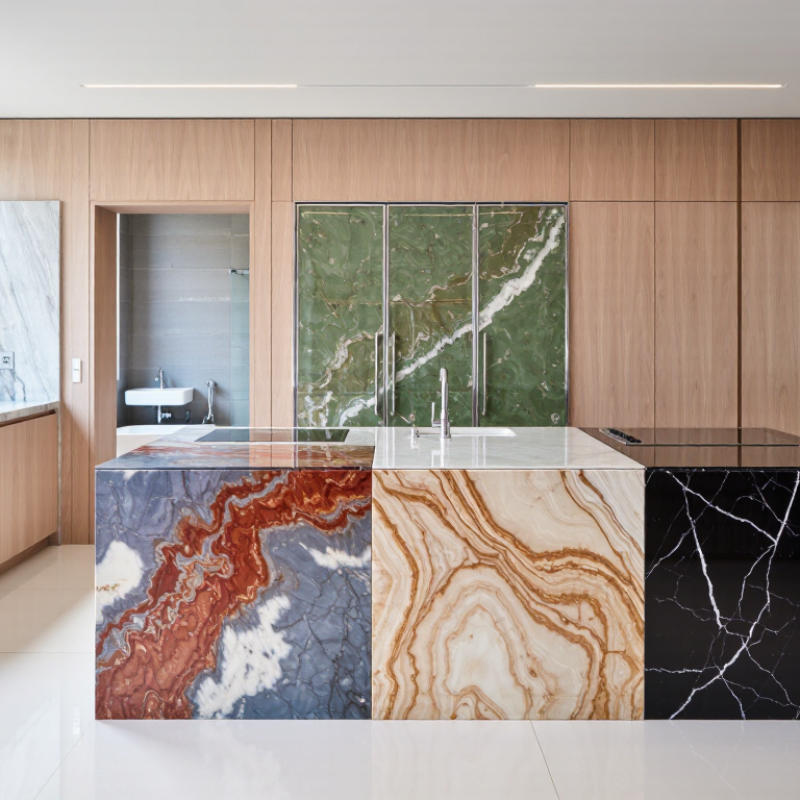
Marble is a calcite-based stone, and that mineral makeup shapes how it performs on a kitchen or bathroom counter. The U.S. Geological Survey lists calcite at Mohs 3; natural marble is often described within a broader 3–5 range because its texture and mineral mix vary. That is softer than many countertop stones. A dropped pan or gritty plate can leave a mark. So can lemon juice, which may dull the polished surface through acid etching. The damage is not always a scratch. That distinction matters.
ASTM C503/C503M, the specification for marble dimension stone, includes tests for properties such as water absorption and flexural strength. Those measurements help characterize stone, but they do not make every slab behave identically in a lived-in kitchen. A pale, polished surface may show etching more clearly than a honed finish. Honed marble can still stain or scratch; it simply reflects less light. In a bathroom, cosmetics and acidic cleaners deserve care near the basin. Use a cutting board, wipe spills promptly, and choose a cleaner labeled safe for natural stone. Small habits help. Still, marble is not maintenance-free, and expecting it to stay untouched may set the wrong standard.
Marble varies sharply in color, veining, and price. Carrara usually has a cool white or gray ground with fine, soft veins, and often sits in a lower-to-mid price tier. Crema Marfil brings warm beige tones and quieter markings. Danby tends toward white with subtle gray lines, though stronger patterns can raise its price. Calacatta and Statuario are brighter, with bold, sweeping veins; select slabs often cost more. Arabescato adds dramatic, looping gray patterns. A small sample can mislead.
For darker kitchens, Nero Marquina pairs black stone with crisp white veins, while Emperador ranges from brown to deep chocolate with lighter webbing. Breccia offers fragmented, varied color; Verde Alpi brings saturated green and pale veining. Their prices depend heavily on slab selection and availability. Angi’s 2025 marble-countertop cost guide puts typical installed costs at about $40–$100 per square foot, with premium choices potentially higher. Treat that as a planning range, not a quote. Fabrication, slab thickness, edge details, and local labor change the final bill. The Natural Stone Institute notes that marble can etch when exposed to acids, such as lemon juice or vinegar. Pale stone looks forgiving in a showroom. Daily spills may tell a different story. Compare full slabs, not just small samples, and ask fabricators to price the exact material and finish.
| Marble Type | Typical Base Color | Veining and Pattern | Typical Installed Cost (USD/sq. ft.) | Good Fit | Care Considerations |
|---|---|---|---|---|---|
| Carrara | White to cool gray | Fine, soft gray veins; generally a relatively subtle, consistent pattern | $40–$100 | Classic kitchens, bathroom vanities, and understated designs | Porous and acid-sensitive; seal as recommended and wipe spills promptly. |
| Calacatta | White to warm white | Bold, broad gray or gold-toned veins, often with strong contrast | $100–$250+ | Statement islands, feature vanities, and high-contrast interiors | Veining and slab appearance vary; protect from acidic foods and cleaners. |
| Statuario | Bright white | Distinctive, dramatic gray veining, often wider than that of Carrara | $100–$250+ | Designs seeking a bright background with pronounced natural movement | Premium slabs can be selective; like other marble, it can etch and stain. |
| Danby | White to light gray | Subtle gray veining, usually fine to moderately defined | $60–$150 | Light-colored kitchens and bathrooms; a domestic marble option | Still requires marble-appropriate care; sealing does not prevent acid etching. |
| Arabescato | White to pale gray | Strong, looping gray patterns with a more intricate look than many plain white marbles | $100–$250+ | Feature surfaces where a pronounced, flowing pattern is desired | Pattern and contrast vary by slab; review the actual slab before fabrication. |
| Crema Marfil | Cream to beige | Fine, irregular beige, gold, or light brown markings | $50–$110 | Warm-toned bathrooms, traditional interiors, and neutral palettes | Can show stains and etching; use a pH-neutral stone cleaner. |
| Emperador Dark | Dark brown | Fine cream or light-brown veins, sometimes with mottled areas | $50–$120 | Dark vanities, accent counters, and warm, richly colored rooms | Dust and water marks may be noticeable on dark finishes; wipe and dry regularly. |
| Nero Marquina | Black | Contrasting white veins, ranging from fine lines to more prominent streaks | $75–$160 | High-contrast islands, bathrooms, and dramatic accent surfaces | Check slabs for consistent color and pattern; avoid acidic cleaners. |
| Breccia Capraia | White to pale gray, often with warm accents | Expressive, irregular veining and brecciated patches in gray, gold, or reddish tones | $100–$250+ | Feature islands and one-of-a-kind surfaces with a varied natural pattern | Slabs can differ considerably; plan seams and layout around the chosen piece. |
| Rosa Portogallo | Pale pink to rose-beige | Soft, cloudy movement with subtle veins and occasional light markings | $60–$140 | Warm, distinctive bathrooms and interiors using muted pink tones | Color varies by slab; protect from acidic products and clean with pH-neutral solutions. |
Cost and care note: Cost ranges are broad U.S. estimates for material and standard installation per square foot; location, slab grade, thickness, edge details, cutouts, and project size can change the final price. Marble is a natural, porous stone that can stain and etch when exposed to acids. Sealing can reduce absorption but does not make marble stain-proof or acid-proof.
ASTM C97/C97M measures water absorption and bulk specific gravity in dimension stone. For marble countertops, absorption data can help indicate how readily moisture may enter the stone. Ask for a test report that matches the marble type and, where possible, the specific production lot. A showroom sample may not reflect every slab.
Numbers matter. A lower absorption result can be helpful, but it does not guarantee stain resistance or prove a stone is right for every room. ASTM C97/C97M does not measure marble’s sensitivity to acids. Lemon juice, vinegar, and some cleaners can dull a polished surface, even when test results look favorable. In kitchens, use cutting boards and wipe spills promptly. In bathrooms, check for lingering water around faucets and soap dishes.
Compare absorption results alongside the stone’s appearance, finish, and care requirements. The test cannot capture every vein or variation across a large slab. That part is easy to underestimate. Sealing may reduce some staining risks, but it will not prevent acid etching. Ask the supplier how the tested material was prepared and discuss maintenance with a qualified stone professional before choosing marble for a busy countertop.
Marble countertops commonly come in 2 cm and 3 cm slabs. The thinner format weighs less and can suit cabinets that need a lighter load. It often needs added support, especially around a sink cutout or a long overhang. A thicker 3 cm slab creates a substantial edge and may simplify installation where extra support is not required. Still, thickness alone does not determine strength. Veining, cracks, cutouts, and how the slab is supported all matter.
Check the cabinets. Before choosing, confirm their condition and ask the installer how each format will be supported. Marble is heavy, and older cabinets may need reinforcement. Measure the overhang carefully; a few extra inches can change the support plan. Small detail, big impact.
Edge profiles also affect appearance: a simple eased edge keeps the stone’s thickness visible, while a built-up edge can make a thinner slab look deeper. Ask to see the actual slab, not only a small sample, since its veining may vary across the surface. I would not choose 3 cm just because it looks more durable; the right fit depends on the stone, layout, and installation.
When comparing ten marble countertop options, judge the finish in the light your room actually gets. Polished marble reflects a bright window and wipes clean easily, but water spots and etching can stand out. Honed surfaces soften glare and disguise small marks; they may show oily fingerprints sooner. Leathered finishes add texture, though crumbs can collect in shallow pits. The trade-off is real. For a busy kitchen, test a sample with lemon juice and a damp cloth before choosing. Marble can etch from acids, even when sealed.
Edge profiles change both the look and daily feel of a slab. A simple eased edge is comfortable to wipe, while an elaborate profile has more ledges for dust and spills. Rounded edges may suit family bathrooms, where sharp corners can catch hips or towels. Sealing needs vary with the stone’s porosity, finish, and use; ask the fabricator which sealer is appropriate and follow its care directions. A quick water-drop test can suggest whether a surface absorbs moisture, but it is not a precise measure. I would not promise that sealing prevents stains or etching. It only adds a layer of protection, and maintenance can be easy to underestimate.
CLA-VAL UK Limited
Dainton House
Goods Station Road
Tunbridge Wells
Kent, TN1 2DR
© 2025 CLA-VAL UK | site map | Terms and Conditions of Sale and Warranty | Privacy policy