Top Non Woven Wet Wipes Manufacturers for Global Buyers?
Choosing a Non Woven Wet Wipes manufacturer is more than comparing unit prices. Global buyers must assess material quality, converting capacity, packaging options, and communication. A sample may feel soft in the hand, yet still tear during use or arrive with uneven moisture. Small details matter.
This guide introduces manufacturers serving different buyer needs, from private-label programs to larger recurring orders. It considers practical indicators such as product range, production experience, quality-control procedures, and willingness to provide clear specifications. Ask about fabric weight, wipe dimensions, lotion distribution, pack counts, and sample approval. Request current documentation where relevant, and verify claims directly with each supplier. No shortlist can replace due diligence.
Price tells only part of the story. Lead times can shift, and a polished catalog does not prove consistent production. Buyers should compare samples under realistic conditions, review order terms, and clarify how defects or delays are handled. That takes time. It is worth it.
The manufacturers discussed here are starting points, not automatic endorsements. Requirements differ by market, application, and order volume, while supplier information can change. Some details may remain difficult to confirm until a buyer speaks with the factory. Keep that uncertainty in view. With careful questions and documented comparisons, global buyers can narrow their options and choose a partner whose capabilities match the product they actually need.
What Are Nonwoven Wet Wipes, and How Do ISO 9073 Tests Measure Their Fabrics?
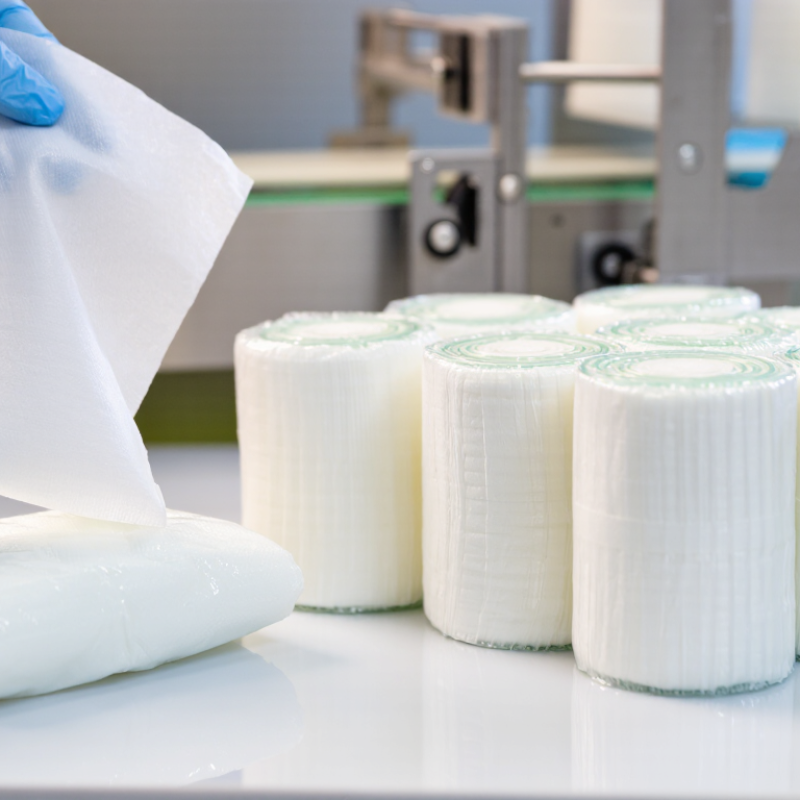
Nonwoven wet wipes combine a liquid solution with a fabric made from fibers bonded without traditional weaving. The sheet may contain natural, synthetic, or blended fibers, depending on its intended use. Its feel can range from soft and drapey to firm enough for wiping textured surfaces. A useful wipe should hold together when wet, absorb liquid, and release it during use. Those qualities depend on both the fabric structure and the lotion.
ISO 9073 is a series of test methods for nonwoven fabrics, not a single pass-or-fail quality grade. Depending on the method selected, testing can measure properties such as thickness, mass per unit area, tensile strength, elongation, and absorbency. For example, tensile testing pulls a strip of fabric until it stretches or breaks. Results help buyers compare samples, but they do not guarantee performance in every wipe format. A folded sheet can behave differently from a narrow test strip.
Testing also depends on sample conditioning, direction of measurement, and the chosen procedure. Small differences matter. A higher tensile result may suggest a stronger sheet, yet it can also mean a less gentle feel. Buyers should review test reports alongside practical checks, such as wet handling and linting. No single number tells the whole story, and a report without clear test conditions deserves a closer look.
Which Nonwoven Materials and Basis Weights Suit Different Wipe Applications?
Wipe performance starts with the right web, not simply a higher basis weight. Spunlace made from viscose, polyester, or their blends is widely used because water-jet entanglement creates a soft, flexible sheet without chemical binders. For facial and personal-care wipes, roughly 35–60 gsm often balances softness and handling. Baby wipes commonly use about 45–70 gsm for a fuller feel and better wet strength. These are practical ranges, not universal specifications; fiber mix, embossing, and lotion loading can change performance.
The Grand View Research report on the global wet wipes market estimated its 2023 value at USD 25.3 billion, reflecting substantial demand across personal-care and household uses. For household cleaning, a polyester-rich or blended spunlace around 50–80 gsm can offer stronger scrubbing and lower lint. Lightweight nonwoven webs may suit single-use dry wipes, while heavier sheets can feel durable but may cost more and leave more material per wipe. Basis weight alone is not proof of strength: test wet tensile, absorbency, lint, and dispensing in the finished product.
Tips: Match the material to the task. Test a wipe after lotion has been added, not only as a dry sheet. A sample that feels strong on the bench can stretch or tear when pulled from a pack. Some applications need a softer sheet more than a heavier one.
How Do Manufacturers Validate Wipe Performance with EN 16615’s Four-Field Test?
For global buyers, a wipe’s claims need evidence beyond a clean-looking surface. EN 16615 evaluates disinfectant wipes using a controlled four-field test on a defined surface, commonly vinyl. The test area is deliberately contaminated with microorganisms and allowed to dry. A trained operator then wipes across four marked fields using a specified technique. It is a practical simulation, not a perfect copy of every workplace.
Laboratories assess microbial reduction in the first field and transfer to the other fields. This matters because a wipe may reduce contamination where it starts but still spread organisms along its path. Reliable validation records the disinfectant, contact time, wipe dimensions, test conditions, and recovery results. Buyers should review the full report, not just a pass statement. Small changes in pressure or wiping pattern can affect results; that detail is easy to overlook.
Tips: Ask for the test report and confirm the tested wipe matches the offered product. Check whether the stated contact time is realistic for your cleaning routine. Compare results from qualified laboratories, and ask how operators were trained. One limitation remains: field performance can vary with soil, surface, and user technique. That uncertainty deserves an honest discussion.
What Quality and Regulatory Checks Should Global Buyers Verify Before Sourcing?
Before choosing a non-woven wet wipes manufacturer, ask for current test reports that match the exact product you plan to buy. A report for another fabric weight or lotion formula may not prove your product is safe or consistent. Check material composition, basis weight, tensile strength, and linting. Ask how these results are measured and how often production batches are tested. Small details matter.
Review the lotion’s ingredient documentation, microbial test results, and preservative checks. Confirm that packaging protects wipes from drying out and that seals stay intact during transport. Request samples from routine production, not only carefully prepared sales samples. Then compare scent, moisture, texture, and wipe strength. Differences can be revealing. For regulated markets, verify that labeling, product claims, and required documents meet the rules in each destination country. Requirements can vary, so a supplier’s general assurance is not enough.
Check factory procedures for traceability, complaint handling, and corrective action. Can the manufacturer identify a batch using a lot code? Can it explain what happens after a failed test? Review certificates, but confirm their scope, issuer, and validity rather than treating a logo as proof. A remote document review is useful, yet it cannot show every shop-floor practice. I would still plan an independent audit when order size or risk justifies it. No checklist removes uncertainty; that is worth admitting.
How Do Production Capacity, Certifications, and Logistics Compare Across Manufacturers?
For global buyers, a wet wipes manufacturer’s real capacity is more than its annual output claim. Ask how many converting lines run daily, what formats they handle, and whether a second shift is available during peak demand. The Grand View Research report on the global wet wipes market estimated its 2023 value at USD 24.7 billion, with projected growth through 2030. A growing market can tighten lead times. Ask for recent production records, not just installed capacity.
Certifications help buyers compare process controls, but check their scope and expiry dates. ISO 9001 covers quality management; it does not certify a wipe as safe for every use. For skin-contact products, request material specifications, microbiological test results, and batch traceability. The OECD’s Due Diligence Guidance for Responsible Supply Chains in the Garment and Footwear Sector is not a wipes standard, but it offers useful supplier-audit questions. Paperwork matters. Still, a certificate alone may miss weak day-to-day controls.
Logistics deserve equal scrutiny. Compare factory location, pallet dimensions, container loading plans, and transit-time estimates. Ask how the supplier protects cartons from moisture and handles delayed shipments. The World Bank’s Logistics Performance Index 2023 compares countries on customs, infrastructure, and shipment timeliness; it can inform route planning, but cannot predict a specific port delay. Request a trial shipment. It may reveal more than a polished brochure.
Top Non-Woven Wet Wipes Manufacturers for Global Buyers
A standards-based sourcing snapshot: production capacity is supplier-specific, while certifications and logistics can be checked against published standards. This chart lists relevant reference standards, not manufacturer ratings.
Ask suppliers for audited output capacity, product-specific certificates, and documented shipping terms. ISO 9001 covers quality management; ISO 22716 provides cosmetics GMP guidance; ISO 13485 applies to medical-device quality management. Incoterms® 2020 defines trade terms, and ISO 28000 addresses security management in supply chains. Applicability depends on product, market, and supplier scope.